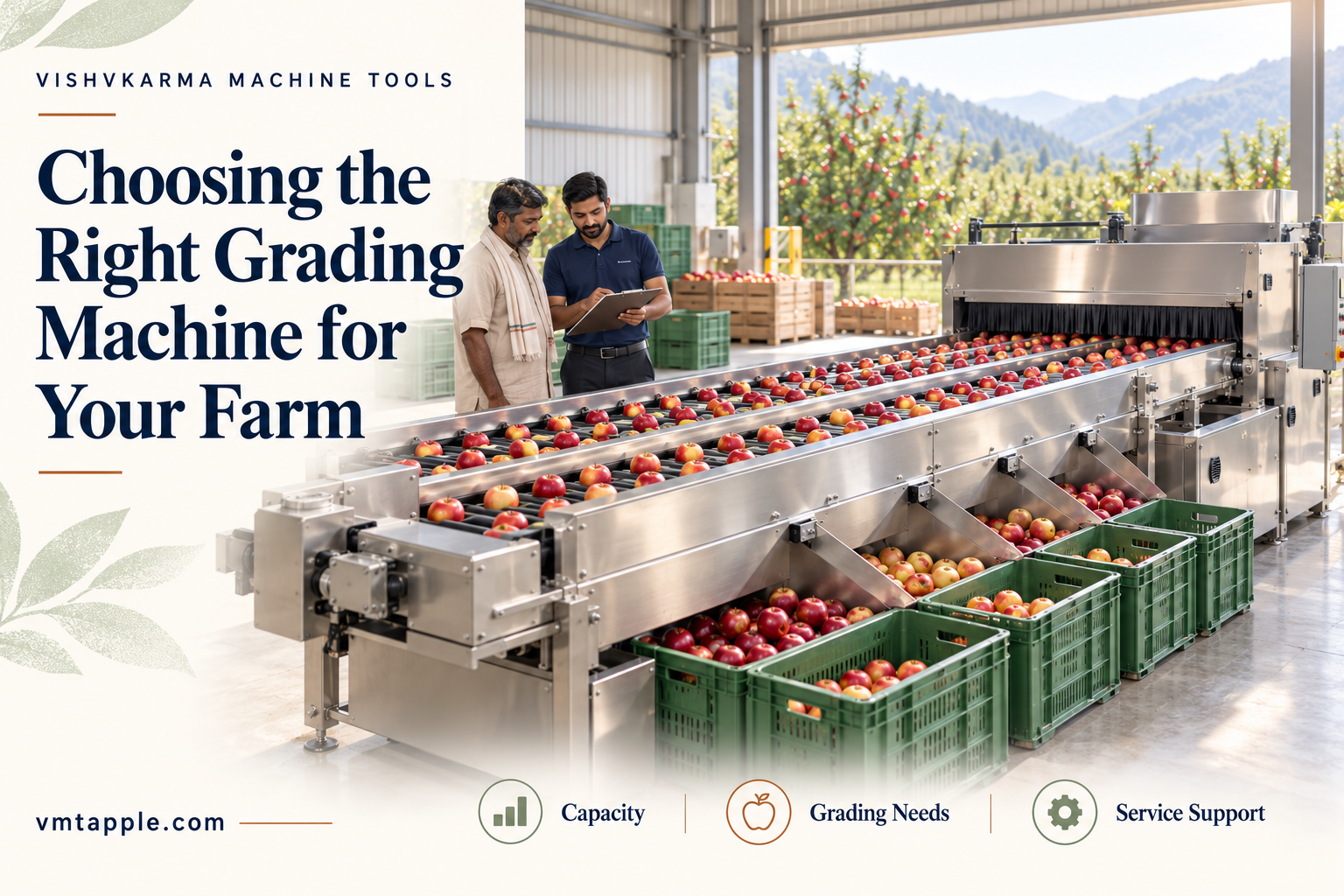
Choosing the Right Grading Machine for Your Farm
A grading machine can make fruit sorting more organised, improve consistency and help prepare produce for different buyers. However, selecting the right equipment requires more than comparing prices or advertised speed.
Your crop, harvest volume, grading requirements and available workspace all influence which machine will suit your operation. Choosing the Right Grading Machine for Your Farm starts with understanding how the equipment will fit into your daily workflow—from receiving harvested fruit to packing finished boxes.
This guide explains the main factors to consider before investing.
1. Start with Your Crop and Its Handling Needs
Different crops require different feeding arrangements, contact surfaces and grading mechanisms. A machine suitable for apples may require changes before it can handle citrus, potatoes or other produce.
Even within one crop, varieties can differ in size, shape and sensitivity to handling.
Before discussing machinery with a supplier, identify:
- The crops and varieties you intend to process.
- The smallest and largest produce sizes.
- Whether fruit arrives wet, dusty or with leaves.
- How sensitive the produce is to bruising.
- Whether you need to process multiple crops during the year.
For a multi-crop machine, ask which adjustments or additional components are required between crops.
2. Define What You Need to Grade
“Grading” can describe several different functions. Decide which characteristics matter to your buyers before choosing a system.
| Grading method | Main purpose | What to confirm |
|---|---|---|
| Size grading | Separates produce by physical dimensions | Supported size range and adjustment method |
| Weight grading | Separates produce into weight bands | Weighing consistency at normal operating speed |
| Optical colour sorting | Groups produce by selected colour characteristics | Lighting, camera coverage and settings |
| Optical defect sorting | Identifies selected visible surface defects | Detectable defects and inspection limitations |
A mechanical size grader does not automatically grade by weight or detect defects. Similarly, optical inspection capabilities depend on the installed cameras, lighting and software.
Ask the supplier to demonstrate the exact functions included in the quoted model.
3. Calculate Your Required Capacity
Choose capacity around your busiest realistic working days. Average seasonal volume alone can hide the pressure created during peak harvesting.
A useful starting calculation is:
Required average throughput = Daily produce volume ÷ Available processing hours
For example, if you need to grade 12 tonnes in six productive hours, the average requirement is 2 tonnes per hour. You should also allow time for cleaning, adjustments, breaks and changes between batches.
Confirm whether the quoted capacity refers to fruit entering the grader or the output of the complete line. Feeding and packing arrangements can limit overall production even when the grading section has spare capacity.
4. Assess Gentle Handling
Fruit appearance matters, so inspect how produce enters, moves through and leaves the machine.
Pay attention to transfer heights, cushioning, roller or cup design, and collection arrangements. Fruit should move smoothly without unnecessary drops or congestion.
During a demonstration, check for:
- Fruit accumulating at feeding points.
- Apples striking hard edges.
- Excessive drops between sections.
- Collection bins becoming overloaded.
- Visible damage after processing.
Where practical, inspect sample fruit again after a suitable holding period, as some bruising may become clearer later.
5. Plan the Complete Working Layout
Machine dimensions are only one part of the space requirement. Your team also needs room to receive crates, move produce, pack boxes and access equipment for maintenance.
Measure the installation area and consider:
- Entry doors and unloading access.
- Power supply location.
- Drainage where washing is included.
- Space for collection bins and packing tables.
- Safe walkways and maintenance access.
- Movement of empty crates and finished boxes.
Request a proposed layout before finalising the order. This helps identify awkward transfers or restricted working areas early.
6. Decide Whether You Need Additional Processing Sections
A grader separates produce into categories. Washing, brushing, drying and other treatments require separate compatible equipment.
Choose these sections according to your crop, buyer specifications and packing process. For example, adding washing also creates requirements for water management, drainage and suitable drying.
Confirm the sequence of operations with the supplier and ask how each section affects throughput, labour and maintenance.
7. Check Power and Utility Requirements
Before ordering, confirm that your farm or packing shed can support the equipment.
Ask for written details covering the required electrical phase, connected load and normal operating requirements. Some configurations may also need water, drainage or compressed air.
Discuss the condition of your local power supply and any protection recommended for electronic controls. These requirements should be clear before installation begins.
8. Compare Total Ownership Costs
The purchase price does not show the full cost of operating a grading machine.
Compare quotations using the same scope, including:
- Freight, installation and commissioning.
- Operator training.
- Electricity and other utilities.
- Labour required around the machine.
- Routine maintenance and consumables.
- Spare parts and service visits.
Also ask what is excluded. A lower quotation may cover fewer processing sections, accessories or installation services.
9. Evaluate Training and Service Support
Operators need to understand feeding rates, grade settings, cleaning and basic troubleshooting. Clear training can help maintain consistent results and reduce avoidable interruptions.
Ask the manufacturer:
- What training is included?
- Which spare parts should be kept on site?
- How are service requests handled?
- What maintenance schedule is recommended?
- What does the warranty cover?
Request operating instructions and maintenance guidance as part of the handover.
10. Arrange a Trial with Your Own Produce
A demonstration using your own fruit is one of the most useful steps in Choosing the Right Grading Machine for Your Farm.
Bring a representative batch containing the sizes and quality variations you normally handle. Agree on the grading settings, then assess output consistency, handling and practical throughput.
Check the collected grades manually and discuss any misclassification with the supplier. A trial helps turn general specifications into evidence relevant to your farm.
Choosing a Grading Solution with VMT
Prepare a short requirement sheet before contacting a manufacturer. Include your crop, peak daily volume, required grades, available space and power supply.
Share these details with Vishvkarma Machine Tools to discuss a grading configuration suited to your operation.
Visit vmtapple.com to explore grading machinery and request a quotation based on your farm’s requirements.
Frequently Asked Questions about Choosing the Right Grading Machine for Your Farm
Which grading machine is suitable for a small farm?
A compact size grader may suit farms with modest volumes and straightforward grading requirements. The right choice depends on crop volume, labour availability and buyer specifications.
Should I choose mechanical or optical grading?
Mechanical grading may suit size-based separation. Optical grading is worth assessing when buyers require colour sorting or inspection for selected visible defects.
Can one grading machine handle multiple fruits?
Some configurations can handle multiple crops, but compatibility must be confirmed. Changes to settings, feeding arrangements or components may be necessary.
How can I check grading performance before buying?
Request a trial with your own produce. Assess grade consistency, practical throughput, handling quality and the labour required around the machine.